Showing posts with label Asus. Show all posts

Jul 17, 2009

ASUS HD TV Monitor T1

ASUS TV Monitor T1 HDTVASUS attempts to grab a slice of the HDTV market pie with the unveiling of its TV Monitor T1 series in Europe, which combines a desktop monitor and LCD TV technology, giving you high-quality HDTV broadcast as well as Full HD Blu-ray Disc playback.

The ASUS TV Monitor T1 has built-in TV tuners, allowing you to watch both digital and PAL/ SECAM channels, maximizing your European viewing pleasure.  Apart from Full HD capabilities, which let you watch high-quality videos in 1920 x 1080 pixels, the ASUS TV Monitor T1 also features surround sound through its 7-Watt speakers, together with a rich complement of I/O ports and ASUS' Splendid Video Intelligence Technology that enhances color reproduction.

The T1 Series also features ASUS Smart Contrast Ratio technology that brings the display's contrast ratio up to 20000:1.  The ASUS TV Monitor T1 comes with a remote control, customizable sound presets, a Splendid Video Intelligence Technology that lets you adjust the display's parameters to ensure optimized colors, and a Splendid Game Mode that boosts those dim and hard-to-see areas in video games all while keeping well-lit area untouched.

Let's hope that a NTSC capable version will come out soon for the North American market. (Link)

Jun 23, 2009

Asus W90Vp : World’s Most Powerful Gaming Laptop

Asus W90Vp is a desktop replacement notebook that offers record-breaking performance in a stylish, aggressively-designed chassis inspired by high-performance luxury vehicles.

asus-w90vBased on an ASUS motherboard using an Intel X38 desktop chipset, the W90Vp boasts a Discrete Graphics Engine (DGE) using a pair of ATI Radeon 4870 videocards with 1GB of video memory in CrossfireX, 6GB of system memory, and an overclockable Intel Core 2 Quad-core processor for class-leading performance. The DGE with its dual Radeon cards offers mind-blowing performance, allowing it to reach over 15,000 3Dmarks in 3DMark06 in overclocked mode – a score that puts all notebooks, and some desktops, to shame.

The W90Vp is a portable movie theater with its Blu-ray drive, glorious 18.4” LCD running at full 16:9 HD 1920x1080 resolution, and an amazing Dolby-certified sound system. The sharp display features an edgeless cover for a true home theater experience that is complimented by booming audio from the integrated 5.1 Altec Lansing speaker system with a built-in subwoofer.

Seven Second Boot with Express Gate
With the W90Vp you can quickly and easily access the web, instant messages, look at photos and more with its Express Gate quick-boot environment. Just press the W90Vp’s Express Gate button and in seconds you’ll be in a fully-functional Linux environment – perfect for quickly checking your email, listening to music, or making a Skype call.

Specifications

Processor and Cache Memory
Intel® Core™2 Duo processor T9600/T9400/P8600/P8400
Intel® X38 + ICH10R Chipset, FSB=1066 MHz

Operating System
Microsoft® Vista 64 bit SP1 Premium

Main Memory
DDR2 800MHz, up to 6GB, 3xSO-DIMM slots support

Display
* 18.4” widescreen HD ultra-bright LCD display (W90Vp/W90Vn)
* 17” widescreen WUXGA ultra-bright LCD display (W90V)

Graphics Card
* ATI CrossFireX™ technology with ATI Mobility Radeon™ HD 4870 graphics, GDDR3 1024MB VRAM (W90Vp)
* NVIDIA GeForce 9800M GS, GDDR3 1024MB VRAM (W90Vn)
* ATI CrossFireX™ technology with ATI Mobility Radeon™ HD 3850 graphics, GDDR3 1024MB VRAM (W90V)

Hard Disk Drive
320 + 320GB / 250 + 250GB / 500 + 500GB (5400rpm)

Optical Drive
Blu-ray Combo/ DVD Super Multi DL

Video Camera
2.0M Pixels Auto Focus Webcam

Communication
* 802.11 Draft N wireless connection
* BlueTooth 2.1+EDR
* 10/100/1000 Mbps Ethernet
* 56k Modem

Audio
* 5.1 channel Altec Lancing speaker (w/ subwoofer),
* 2nd Generation Dolby™ Home Theater

Interface
* 1 x HDMI
* 1 x E-SATA
* 4 x USB 2.0
* IEEE 1394
* VGA-out (D-Sub)
* Headphone (SPIDIF)
* Mic-in
* 8 in 1 Card Reader
* 1 x Express Card
* 1 x CIR
* RF-in (w/ TV SKU)
* 1 x Modem jack (RJ11)
* 1 x LAN port (RJ45)

The W90Vp-A1 features an introductory MSRP of $2,499 USD and is available immediately at leading online e-tailers. (story Link)

Asus EEE Top : All in One TouchScreen Desktop Computer

Evolving the ASUS EEE PC line up, ASUS have released the ASUS EEE Top. A desktop version of the ASUS EEE PC, with a difference; that difference being the EEE Top has a touch screen.

ASUS Eee Top, all-in-one touchscreen computer, is equipped with 15.6” LCD screen for easy and convenient manipulation. Simplicity of use; Eee Memo enables users to write messages for their family members on desktop ‘stickies’ with just their fingers. SoftStylus allows them to input text without requiring a physical keyboard. Surfing the Internet is also possible without a mouse, thanks to Opera Touch, a rich-featured web browser enhanced for touchscreen use that supports drag-and-drop functions.

“ASUS Eee Top” features with Windows® XP, Wi-Fi 802.11n connectivity for speedy and reliable Internet access, the integrated Hi-Fi speakers & SRS TruSurround HD™ technology, the integrated 1.3 megapixel web camera, and microphone array for convenient web conferencing.

Main Specifications:
  • ScreenSize: 15.6" (16:10 Wide Panel)
  • Touch Screen: Single Touch Panel
  • OS: Windows XP Home (SP3)
  • CPU: Intel ATOM (1.6GHz/533MHz FSB/512K Cache)
  • Chipset: Intel 945GSE + ICH7M
  • Memory: 1GB (DDR2 667)
  • Storage: 160GB, SATAII 5400rpm
  • Graphics: Shared Graphics (128MB)
  • Webcam: 1.3 Mega Pixel
  • Communication: 10/100/1000 Mbps Ethernet
  • WLAN: WiFi 802.11b/g/n
  • AC Power: 19Vdc, 4.74A, 65W power adaptor
  • Net Weight:4.3Kg Price Range £399.99 - £449.99 Play.com

Apr 28, 2009

ASUS Nova P22 Mini PC Is No Small Wonder

Asus2

If you like a liquid-cooled, oversized, overclocked, loud-as-a-harrier-jet, game-scorching PC tower, then ASUS’ new Nova P22 is not for you. At 9 in x 7.2 in x 2 in, it's a little longer and wider than a Mac Mini, in an aesthetically pleasing not-square chassis. Inside: a 1.8-GHz Core 2 Duo chip, an adequate Intel GMA 3000 graphics processor, 1 GB of ram, and a 160-GB hard drive. Almost enough oomph to run Vista — but not Doom. That’s OK, though, because the Nova was designed for your living room, not your game lair. Essentially it acts as a media streamer. We grabbed a DVI to HDMI cable, jacked it into our TV, and were using the Nova to pull movies off our home network within minutes of hitting the swank, touch-sensitive power button. Gaming be damned —Nate Ralph

Asus3_2WIRED: Decent price for the form factor. Media savvy as advertised. Analog and digital audio outs. Small and quiet. Sleek black finish is purty. 802.11n and Bluetooth 2.0 hardwired beneath its tiny carapace. Looks a lot like a Wii, if that does anything for you.

TIRED: Accidental shutdowns courtesy of the touchy power button. Strictly DVI video outputs, and this is an HDMI world. Built-in pencil holder (!) is useless if you stand the machine upright. Onboard “hi-fi” speakers could barely fill a small closet with sound. Cord management is tricky since all the inputs are on the back. Slightly underwhelming stats aren’t much good for tasks beyond media playing and sharing. $899, asus.com (story Link)

Mar 8, 2009

Battle for Best High-End Mac OS X netBook

I’ve been busy installing OS X on the Dell Mini 9 (CNet review) and fellow podcaster Rob Parker prefers the Acer Aspire One (review) but guest blogger Bob DeGrande thinks that the Asus 901 (review) and MSI Wind(review) make better high-end Mac OS X netbooks.

I think there is a better deal on a Linux netbook at the moment. The Asus 901is a high end netbook.  It normally sells in the $360-380 range, but there is a $100 rebate going on through early March, bringing it into the same price range as the Aspire.

It has excellent features - a 1.3MP webcam, Bluetooth, 6-cell battery, 20GB of SSD in the Linux version, and a Synaptic touchpad which supports two finger scrolling like a MacBook. The Asus 901 network card identifies itself internally as a gigabit card (even though the specs say 10/100) and it also has 802.11n wireless (most others only have b/g).

http://www.tristarcctv.com/images/msi_wind_black_425%5B2%5D.jpgI have some experience running OS X on a netbook (I have a legal license). I use the MSI Wind. I have upgraded to 2GB RAM, a 7200 RPM 320GB hard drive, and a 9 cell battery.  It’s still under 3 lbs., and this machine runs OS X well - I load up Spaces with Tweetdeck, Firefox, Mail, and iTunes, and I have no problem running additional applications without slowing down.

Time Machine works, including using Migration Assistant to move apps from an existing Time Machine backup by USB.  There are some minor issues, I have to run a program to switch between speaker and headphones and there is a program that runs at startup to connect to Wi-Fi, but that is automatic. I am also dual booting XP, as I have a digital TV USB stick that only works with Windows.

BoingBoing has recently updated their compatibility chart for netbooks running OS X. What’s your favorite netbook for running Mac OS X? (story Link)

Feb 28, 2009

Review: Samsung NC10-14GB

From cell phones to HDTVs, Samsung products have successfully found their way into American homes for the past decade. But the company hasn't made much headway with its laptops, and for good reason: The laptops have only recently started selling in the United States. Samsung needed a strategy that would jump-start its laptop presence. A netbook was the obvious choice, as this category is taking the market by storm. The Samsung NC10-14GB ($480 street) is a lot like every other netbook, but it has a few small advantages. It comes with a six-cell battery instead of a puny three-cell, and the keyboard is a tiny bit (1 percent) bigger than those of the MSI Wind and the HP Mini 1000. Ultimately, though, it loses out on price: The MSI Wind is a lower-priced package for now (by about $50, which in the netbook category is significant).

The white exterior of the ASUS EeePC 4G, once thought of as sleek and sexy, has been copied over and over for other netbooks like the Wind, the Acer Aspire One, and the Lenovo IdeaPad S10. Splashed in navy blue, the NC10 is neither bland nor head-turning. The HP 1000's embedded patterns and the metallic lid of the ASUS EeePC 1002HA are taking netbook designs to another level, and the trend won't stop with them. At 10.3 by 7.3 by 1 inches, the NC10's dimensions practically identical to those of the ASUS EeePC 1002HA. The HP Mini 1000 (10.3 by 6.6 by 0.9 inches) and the Lenovo S10 (9.8 by 7.3 by 0.9 inches) are slightly thinner and smaller. At 2.9 pounds, the NC10's frame seems heavy, but once you factor in the standard six-cell battery, its weight is actually on a par with its 10-inch counterparts.

By 10-inch, I mean the size of the widescreen. Netbooks like the Acer Aspire One (2.1 pounds), the Dell Inspiron Mini 9 (2.3 pounds), and the ASUS EeePC 900 (2.2 pounds) are noticeably lighter because they have smaller 8.9-inch widescreens. The viewing experience is obviously better with a bigger screen, but the 1,024-by-600 resolution is the same across the board. The NC10's brightness and contrast levels are consistent with those of other 10-inch netbooks and make for pleasant viewing. Its 93 percent keyboard is 1 percent larger than those found on the Mini 1000 and the MSI Wind—not a huge difference, although the keys are noticeably bigger and the typing experience better. Consequently, the touchpad is minuscule compared with those of the EeePC 1002HA and the Wind, resulting in a tighter pinch when using your thumb and index fingers to navigate.

The NC10's features are consistent with those of other top-rated netbooks. It comes with three USB ports, a VGA-out, an Ethernet port, and an SD slot. Lenovo opted to forgo a USB port in its S10 to make room for an ExpressCard slot, which is a handy addition for expansion devices that enable 3G wireless services and other specialty ports. Both the HP 1000 and the Dell Inspiron Mini 9 have 3G wireless built in, simplifying things even further. A 160GB hard drive is included and appears to be the capacity that everyone is settling on. By next year, you'll see netbook hard drive capacities standardized at 320GB.

The NC10 contains the same parts as every netbook. Its 1.6-GHz Intel Atom N270 processor and 1GB of memory are no surprise. The same could be said about the integrated graphics. The ASUS N10Jc-A1 is an exception, a netbook that utilizes two sets of graphics chipsets to its advantage—one for 3D work and another to save battery life. The NC10's SYSmark 2007 Overall score topped the Wind's by a point, though you wouldn't notice it in real-world applications. The NC10 was a bit slower on video-encoding tests, trailing the others in the comparison by at least 2 seconds. (full Story)

Asus G50V Gaming Laptop Launched for India Costumers

Asus has announced the launch of the Asus G50V gaming laptop in India.

The G50V looks at delivering extreme gaming performance with intense visual computing power and is equipped the G50V with an Nvidia GeForce 9700M GT graphics processor backed by 512MB of dedicated GDDR3 memory. The 9700M has 32 DirectX 10-class "compute cores" and a 128-bit memory interface, and it is largely derived from the G96 GPU that powers desktop graphics cards like the GeForce 9500 GT. The G50V a 15.6" LCD and comes equipped HDMI, LifeFrame, SmartLogon and Virtual Camera and comes with double SATA hard disc drive (up to 640GB).

Stanley Wu, Country Head for Notebook Business, Asus India said, "We believe in providing the best technology in all our product categories to our customers. The G50V is one of the most revolutionary products in the high end gaming category. With a gaming focused design and strong graphics, the Asus G50V will redefine performance and enhance the entire gaming experience for the user."
The laptop comes bundles with a Republic of Gamers backpack, a 1600dpi mouse and a Siberia Steelseries Gaming Headset.

The Asus G50V is priced at Rs. 1,15,000. (story Link)

Feb 2, 2009

Sony’s Lifestyle PC VGN-588EQ

It was more than two years ago that Mike Abary, senior vice president at Sony, reached into his inner suit pocket and pulled out the Sony VAIO VGN-UX180P. At the time, he called this handheld PC, which ran a full-blown version of Windows XP, "an achievement in ingenious design." Little did he know he'd be pulling the same stunt again at a quaint hotel in Manhattan, where I was one of a handful of journalists invited to preview Sony's take on the netbook revolution. He reached into his suit jacket and pulled out a clamshell the length of two UX180Ps, not even an inch thick. This, as he described it, is Sony's answer to the surging netbook market, only it's not being classified as a netbook, it's not an update to the UX180P, and the intended audience, interestingly enough, is women. It's the Sony VAIO VGN-588EQ ($1,199 direct), better known as the Sony Lifestyle PC.

The Lifestyle PC is unlike anything you've seen before, in large part because of the 8-inch LED widescreen, the first of its kind. Even from afar, you may feel a tingling sensation as soon as you lay eyes on it, and your first instinct is to pick it up. Sony handed me a review unit while I was at the CES 2009 show in Las Vegas, allowing me to use it in multiple scenarios. I really don't want to call this a netbook, but there's no other way to classify this gorgeous device. It runs the Intel Atom platform, it's inexpensive for a Sony-branded laptop, and the keyboard is undersized—all netbook symptoms. On the other hand, it's so much more than a netbook. It weighs half as much as one and packs in features like 3G wireless, a pre-boot Linux environment, and a high-resolution screen. Although the Lifestyle PC is now at the pinnacle of design engineering, performance is an issue when Windows Vista is the only operating system offered, and the price is over $1,000 with the solid-state drive option. Based on design alone, though, I think Sony can create a huge following with this pseudo-netbook.

Even though there are no ties between them, the Lifestyle PC conjures up images of Intel's Moorestown concept device. It weighs a mere 1.4 pounds, only 0.2 pound heavier than the original UX180P. And it measures 9.7 by 4.7 by 0.8 inches, which is about the length of the ASUS EeePC 1002HA but only half its depth. It fits nicely in the inner pocket of a suit jacket or a Coach clutch bag, and is thin enough that you can slide two of them into a manila envelope. Its look is unique, and its design intentions are clear: Sony wants to dissociate the Lifestyle PC from the likes of the MSI Wind, the ASUS EeePC, and the Acer Aspire One—some of the more popular netbooks in the market. In my opinion, it has successfully done so. (full Story)

Jan 12, 2009

Windows 7 Puts it’s Finger on Enhanced Biometric Support

I’ve always found biometrics to be an interesting aspect to technology. And I was excited to discover that Windows 7 offers changes to the way Windows handles biometrics to enable better experiences. Windows 7 introduces the Windows Biometric Framework which makes integration easier and more consistent to help deliver enhanced reliability, compatibility and usability of fingerprint-based solutions. The Windows Biometric Framework also makes it easier for developers to include biometrics in their applications by providing a common API that can be added independently with each biometric fingerprint solution. For a more in-depth look at the Windows Biometric Framework check out this whitepaper from Windows Hardware Developer Central.

This week at CES 2009, we have several key partners announcing support for the Windows Biometric Framework in Windows 7.

With tens of millions of notebooks in the market with UPEK fingerprint sensors, UPEK has worked closely with us on the development of the Windows Biometric Framework and sees strong value in using applications that support fingerprint biometrics through the Windows Biometric Framework. If your laptop uses a UPEK fingerprint sensor, such as my Lenovo X300, you can download the pre-release Protector Suite software here which utilizes the Windows Biometric Framework in the Windows 7 Beta today. I’m currently testing it out myself and its pretty slick! Rob Blau, UPEK’s Vice President of Development, talks more about UPEK’s support for Windows 7 here in their press release (Word Document).

AuthenTec has also worked closely with us on the development of the Windows Biometric Framework. They are providing beta test participants with access to software that enable convenient logon for Windows 7-based PCs, thanks to AuthenTec fingerprint sensors integrated with the new Windows Biometric Framework. You can download their 32-bit software here and their 64-bit software here. AuthenTec fingerprint sensors can be seen in business and consumer notebooks from the world’s leading brands from ASUS, Acer, Dell, Fujitsu, Fujitsu Siemens, HP, Lenovo, LG, Samsung and Toshiba. Andy VanDamia, AuthenTec’s Director of PC Software, discusses working with us on the Windows Biometric Framework here.

And Validity believes the Windows Biometric Framework facilitates greater adoption of fingerprint security solutions by providing a flexible platform, enabling easy fingerprint sensor integration into PCs.

The early adoption and readiness by these companies has played a vital role in validating the suitability of the Windows Biometric Framework as a platform for fingerprint biometric devices in Windows 7. (story Link)

Jan 9, 2009

Why the Budget All-in-One Desktop Will Fail

LAS VEGAS — Several manufacturers are scooping out the guts of netbooks and implanting them in inexpensive, all-in-one desktop computers. And even though they're cheap, it's unlikely these desktops will break into the mainstream.

Multi-Star International (MSI), Asus, Viewsonic and Shuttle showcased various budget all-in-one desktops at the Consumer Electronics Show in Las Vegas. And hardly any convention attendees even appeared to care about the devices; most of their attention remained fixated on mini notebooks.

MSI is proving to take this new category most seriously with four all-in-ones on display at CES. Dubbed the NetOn series, the computers included the same processor and chipset as the MSI Wind netbook. They range from $500 to $800, depending on screen size (from 16 to 22 inches) and other configurations such as optional touchscreens.

Of course, these companies are embracing this new marketing direction with two trends in mind: 1.) Budget devices, such as netbooks, are flourishing largely because consumers are spending less in a failing economy; and 2.) All-in-one compartmentalization is also highly desirable, as proven by the phenomenally popular iPhone. (full Story)

Hands On with Sony's Answer to the Netbook

It was over two years ago that Mike Abary, senior vice president at Sony, reached into his inner suit pocket and pulled out the Sony VAIO VGN-UX180P. At the time he called this handheld PC, which ran a full blown version of Windows XP, "an achievement in ingenious design." Little did he know he'd be pulling the same stunt again recently at a quaint hotel in Manhattan, where I was one of the few journalists invited to preview Sony's take on the netbook revolution.

Abary reached into his suit jacket and pulled out a clamshell the length of two UX180Ps, but not even an inch thick. He described it as Sony's answer to the surging netbook market—only it's not being classified as a netbook, it's not an update to the UX180P, and the intended audience, interestingly enough, is women. It's called the Sony VAIO P-Series or simply, the Sony Lifestyle PC.

Even though there are no ties between them, the Lifestyle PC conjures up images of Intel's Moorestown concept device. It weighs a mere 1.4 pounds, only two-tenths of a pound heavier than the original UX180P. And it's about the length of the ASUS eeePC 1002HA but only half its depth, looking like an oversized TV remote with a lid. Its look is unique, and its design intentions are clear: Sony wants to dissociate the Lifestyle PC from the MSI Wind, the Asus eeePCs, and the Acer Aspire One—some of the more popular netbooks in the market. In my opinion, it has successfully done so.

The 8-inch LED screen is unlike anything you'll see on a netbook, or a laptop for that matter. In order to maintain its physical dimensions, the vertical height of the screen had to be compressed, making the screen appear extraordinarily wide. It's clearly smaller than the 10-inch screens found on the Wind and the 1002HA, but the screen resolution is what makes everything gel.

Practically every netbook uses a 1,024 X 600 resolution; the Lifestyle PC's native resolution is 1,600 X 768. Such a resolution can fill up the screen, for instance, with three file Explorer windows without any overlap. There's even a Windows Arrangement button (next to the mouse buttons) that will neatly tile your application windows together. Increasing the resolution of such a small screen could cause problems with text, but text and icon sizes were tolerable and the potential of watching a video while Microsoft Word and Powerpoint are fully opened on each side is very compelling. (full Story)

Dell Studio XPS 16

Dell wants you to know that its latest Studio XPS line brings with it a level of prestige—a refined segment for customers who seek luxury and style. The Dell Studio XPS 16 ($1,804 direct) accomplishes just that, succeeding the XPS M1530 as Dell's new bad-boy media center. Seeing how every laptop maker is putting in the same processors and advertising 4GB of memory, home-theater features, and big screens, Dell decided to raise the bar with the XPS 16. Design is its biggest differentiator, as it uses not just one but a number of the hottest techniques in manufacturing. Its display is none too shabby as well. Photographers and professionals can reap the benefits of the RGB LED widescreen and the 1080p resolution without paying outrageous prices for them. For this, the XPS 16 reigns as our new Editors' Choice for the media center category, trumping the HP HDX16t.

The lid is clearly one of the main attractions. It takes its cues from trendsetters like the aluminum Apple MacBook Pro 15-inch (Dual Graphics), the leather-clad ASUS U2E-A2B, and the HP HDX16t with its polished exterior, mixing a little bit from each of these laptops in a manner reminiscent of an exotic drink: one part black leather trimming, one part aluminum accent, and two parts lacquered top. The lacquered part is defined by a process called In-Mold Decoration, similar to the one perfected in the HDX16t, which allows different designs to be placed between the glossy coating and the magnesium alloy skeleton.

At 6.9 pounds, the XPS 16 is not an ideal companion for road warriors, although it's more portable than the Gateway MC7803u (7.7 pounds) and the Acer Aspire 6930G-6723 (7.2 pounds). It's a smidge heavier than the HDX16t, and for good reason: The XPS 16 uses a big 85-Wh (nine-cell) battery, as opposed to the HP's 56-Wh (six-cell) option. The XPS 16 has its own six-cell option, which would bring its weight down to 6.5 pounds, thus making it as light as the Sony VAIO VGN-FW198UH (6.4 pounds). I'll get to why the nine-cell battery is the best option a little later. (full Story)

Jan 7, 2009

Atom-Powered HP Mini 2140

The HP 2133 Mini-Note was and still is ahead of its time, design-wise, with an aluminum finish that made the original ASUS eeePC 4G look like an infant's toy.

As one of the first netbooks that cultivated a revolution, it was enticingly presented and crafted to look like its Elitebook business siblings. But it wasn't without flaws. Specifically, the Via processing innards weren't at all speedy and required excessive cooling, resulting in significant fan noise and heat coming from the base.

The newly minted HP Mini 2140 changes all that, replacing the older parts with faster and more energy-efficient ones from the Intel Atom platform while keeping the impeccably fresh design intact. It's basically a business and education version of the HP Mini 1000, and will be presented this week at CES 2009 in Las Vegas.
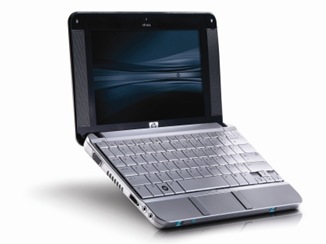
HP_netbook_2140_CybersSystem.BlogSpotFrom the outside, you can't tell the Mini 2140 from its predecessor. The aluminum alloy finish, a glaring departure from the white lacquered designs of the Acer Aspire One, the MSI Wind, and the Lenovo IdeaPad S10, is what made the Mini-Note exceptional in the first place. The 2140, starting at 2.6 pounds (with the 3-cell battery), is slightly lighter than the 2133. It's as heavy as the Mini 1000 (2.5 lbs) and the MSI Wind (2.6 lbs), and a bit heavier than the Acer Aspire One (2.1 lbs), the lightest in the netbook category.

The 2140 could've been as light the Acer One had it not moved to a bigger screen. It now sports a 10-inch widescreen like those of the Wind, the Mini 1000, and the ASUS eeePC 1002HA, rather than an 8.9-inch one. The 1,366-by-768 resolution is a first for a 10-inch screen, a departure from the 1,024-by-600 ones found on most netbooks. The 92% keyboard is one of the biggest, as big and as nice to type with as the Wind's, the 1002HA's, and the Mini 1000's. The Samsung NC10-14GB's, keyboard, however, has a miniscule advantage with its 93% keyboard. As with its predecessor, an exceptional keyboard doesn't help the placement of its mouse buttons, as as they flank the touchpad on either side). I found it easier to navigate with two hands.

The 2140 ranks high in features. Its 2 USB ports don't sound impressive, but foregoing a third USB port for an ExpressCard 34 slot is a wise choice. This slot can be used to expand its capabilities, by adding, for instance, FireWire ports, extra USB ports, a TV tuner, or mobile broadband.

Oddly enough, this business netbook doesn't integrate mobile broadband or 3G wireless. Meanwhile, the Mini 1000 – a consumer netbook, mind you – does. Otherwise, the 2140 has an impressive selection of storage options, including 160 Gbyte (5,400 and 7,200 RPM) spinning drives or an Intel 80-GB solid-state drive (SSD). Capacity-wise, the Samsung NC10 has a slight edge with its 320-GB, 5400rpm drive. Like all netbooks, the 2140 comes with an SD slot for digital camera cards and a webcam for video chatterboxes.

Performance is a complete turnaround from the original 2133. The Via processor, coupled with S3G graphics, was simply too slow compared to other netbooks. Heat dissipation was another issue, as you could hear the fan kick in on a regular basis. (full Story)

AMDs New Athlon Neo Enters the Netbook Matrix

Intel-based netbooks are arguably the most talked-about platforms to date. AMD finally has an answer to them: the Athlon Neo.

Monday night, AMD launched its Yukon platform at the Consumer Electronics Show (CES), consisting of the AMD Athlon Neo processor and either an ATI Radeon HD 3450 discrete GPU or the X1250 integrated graphics.

While the platform won't compete with the likes of the MSI Wind, the ASUS eeePCs, and the rest of the netbook market. AMD has said it believes that there's a void that needs to be filled in the 12- and 13-inch space (referring to the size of the screens), and netbooks are too small and aren't providing the profit margins the company needs to succeed in this space. In layman's terms, AMD wants to offer its customers an oversized netbook for under $1,000.

The Athlon Neo is supposed to be the equivalent of the Intel Atom processor, only it's much larger and less energy efficient, which is why the company is targeting laptops that are bigger but are still considered ultraportables. It will designate a line of "slim and stylish" notebooks, according to Bahr Mahony director of notebook product marketing for AMD.

The Neo's footprint measures 27 mm by 27 mm and has a thermal envelope of 15 watts. Compared to the Atom's 22-by-22 mm footprint and its 2.5W thermal envelope, you can see why the Athlon Neo's not really meant for anything that has a sub- 12-inch screen. At this launch, there will be a single Neo variant—the 1.6GHz Ahtlon Neo, and one of the first laptops to showcase it is the HP Pavilion DV2. Similar notebooks will cost between $699 and $899, Mahony said.

Since the Neo is a larger package than the Atom, expect performance scores to be better than those of netbooks: 2.5 times faster than a 1.6-GHz Atom and GMA 950 platform, although 30 percent slower than a 1.6-GHz Core 2 Duo, which is also considerably more expensive.

The single-core Athlon Neo processor features a 512MB L2 cache, Direct X 9 graphics, and support for 667MHz DDR2 memory.

Like all platforms, whether AMD or Intel, the processor makes up a portion, albeit a huge one, of the Yukon platform. The graphics subsystem is the other part. A Neo laptop will be paired either with the ATI Radeon HD 3450—a discrete GPU for light 3D applications, games, and high-definition video—or ATI Radeon X1250 UMA graphics, for better battery life. There isn't a wireless component, as is common in Intel platforms. As always, AMD will leave it up to third-party players like Atheros and Broadcom to address this void. (full Story)