Showing posts with label Nvidia. Show all posts

Mar 1, 2010

Following a successful run with the codenamed R700 family of GPUs, which was originally released back in June 2008 as the Radeon HD 4000 series, AMD is launching the highly anticipated R800. Debuting to no one's surprise as the ATI Radeon HD 5000 series, on our test bed today we have a reference HD 5870 graphics card packing some 2150 million transistors and produced on a 40nm process.

The new Radeon HD 5000 series is said to deliver around 2x more performance than previous generation Radeon cards, and brings DirectX 11 support to desktops for the first time. Even while Nvidia is downplaying the latter, AMD sees it as a great advantage and expects DX11-capable games to start shipping before the end of the year.

Nvidia will also support DirectX 11 on future hardware of course, but the way things are going it looks as though we'll still have to wait a few months before their response to the new Radeon HD line arrives.
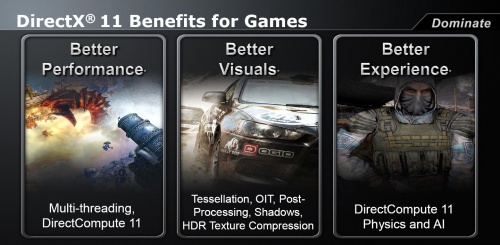
DirectX 11

AMD's pricing strategy with the Radeon HD 5000 series will be quite interesting too, as for the first time in a long while the company will be looking to take the performance crown from Nvidia. Previous generation ATI graphics cards have been unable to compete with the fastest Nvidia solutions, forcing AMD to heavily discount their products in an effort to deliver better value.

In the end the Radeon HD 4850 was competing with the much older GeForce 9800 GTX, while the Radeon HD 4870 ran somewhat unopposed at $299. At this price point the 4870 delivered an impressive level of performance, though it was overshadowed by improved GeForce GTX graphics cards over the next 12 months.
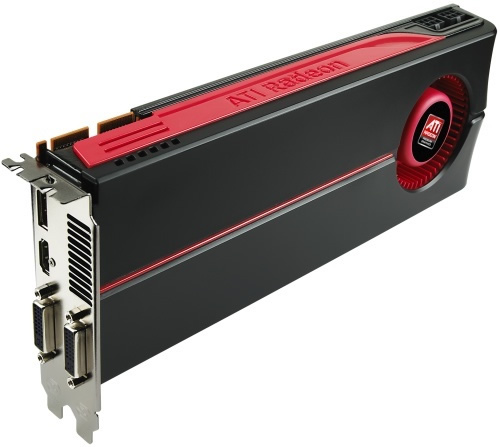
Radeon HD 5870 board

The new Radeon HD 5870 is in a very different position, though. This time around it looks like AMD is not going to be forced into a pricing war as easily -- at least not yet anyway. So for now the HD 5870 makes its debut with an MSRP of $380, while the Radeon HD 5850 is also arriving today priced at around $260.

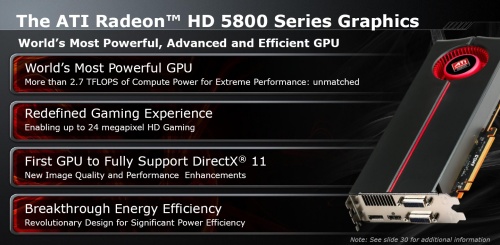
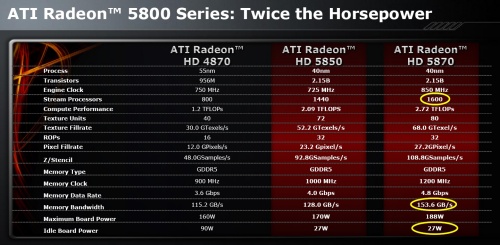
This makes the Radeon HD 5870 roughly $120 cheaper than today's undisputable performance champ, the GeForce GTX 295. It also makes it almost twice as costly as the Radeon HD 4890, however, which begs the question: is the Radeon HD 5870 really that much faster? Today we finally get to find out, as we will be comparing AMD's latest and greatest against every single high-end graphics card released over the past year. (Full Story Link)

Jun 24, 2009

NVIDIA Tesla C1060 Computing Processor – Build Your Personal SuperComputer

This is not a Video Display Card/Board

The NVIDIA Tesla C1060 transforms a workstation into a high-performance computer that can dramatically outperform a small cluster. This gives technical professionals a dedicated computing resource at their desk-side that is much faster and more energy-efficient than a shared cluster in the data center. The Tesla C1060 is based on the massively parallel, many-core Tesla processor, which is coupled with the standard CUDA C programming environment to simplify many-core programming. The Tesla C1060 allows you to keep pace with the increasing demands of the toughest computing challenges including drug research, oil and gas exploration, and computational finance and its many-core architecture meets the computational demands of applications whose complexity has outstripped the CPU’s ability to solve them. This NVIDIA HPC Computing Processor uses the only C language environment that unlocks the many-core processing power of GPUs to solve the world’s most computationally-intensive challenges. Capable of 933 GFLOPs/s of processing performance puts it near the performance of small supercomputers and 4 GB of GDDR3 memory onboard gives you a total bandwidth of 102 GB/s.

Specifications

GPU/VPU: NVIDIA Tesla C1060
Additional Features: Nvidia CUDA Technology
Video Memory: 4 GB
Memory Type: GDDR3
Memory Interface: 512-bit
Core Clock: 1296 MHz
Memory Clock: 800 MHz
Stream Processors: 240
Memory Bandwidth: 102.0 GB/sec.
Interface Type: PCI Express 2.0
Interface Speed: x16

Price US$ 1699-1799 Tigerdirect.com

Jun 23, 2009

Asus W90Vp : World’s Most Powerful Gaming Laptop

Asus W90Vp is a desktop replacement notebook that offers record-breaking performance in a stylish, aggressively-designed chassis inspired by high-performance luxury vehicles.

asus-w90vBased on an ASUS motherboard using an Intel X38 desktop chipset, the W90Vp boasts a Discrete Graphics Engine (DGE) using a pair of ATI Radeon 4870 videocards with 1GB of video memory in CrossfireX, 6GB of system memory, and an overclockable Intel Core 2 Quad-core processor for class-leading performance. The DGE with its dual Radeon cards offers mind-blowing performance, allowing it to reach over 15,000 3Dmarks in 3DMark06 in overclocked mode – a score that puts all notebooks, and some desktops, to shame.

The W90Vp is a portable movie theater with its Blu-ray drive, glorious 18.4” LCD running at full 16:9 HD 1920x1080 resolution, and an amazing Dolby-certified sound system. The sharp display features an edgeless cover for a true home theater experience that is complimented by booming audio from the integrated 5.1 Altec Lansing speaker system with a built-in subwoofer.

Seven Second Boot with Express Gate
With the W90Vp you can quickly and easily access the web, instant messages, look at photos and more with its Express Gate quick-boot environment. Just press the W90Vp’s Express Gate button and in seconds you’ll be in a fully-functional Linux environment – perfect for quickly checking your email, listening to music, or making a Skype call.

Specifications

Processor and Cache Memory
Intel® Core™2 Duo processor T9600/T9400/P8600/P8400
Intel® X38 + ICH10R Chipset, FSB=1066 MHz

Operating System
Microsoft® Vista 64 bit SP1 Premium

Main Memory
DDR2 800MHz, up to 6GB, 3xSO-DIMM slots support

Display
* 18.4” widescreen HD ultra-bright LCD display (W90Vp/W90Vn)
* 17” widescreen WUXGA ultra-bright LCD display (W90V)

Graphics Card
* ATI CrossFireX™ technology with ATI Mobility Radeon™ HD 4870 graphics, GDDR3 1024MB VRAM (W90Vp)
* NVIDIA GeForce 9800M GS, GDDR3 1024MB VRAM (W90Vn)
* ATI CrossFireX™ technology with ATI Mobility Radeon™ HD 3850 graphics, GDDR3 1024MB VRAM (W90V)

Hard Disk Drive
320 + 320GB / 250 + 250GB / 500 + 500GB (5400rpm)

Optical Drive
Blu-ray Combo/ DVD Super Multi DL

Video Camera
2.0M Pixels Auto Focus Webcam

Communication
* 802.11 Draft N wireless connection
* BlueTooth 2.1+EDR
* 10/100/1000 Mbps Ethernet
* 56k Modem

Audio
* 5.1 channel Altec Lancing speaker (w/ subwoofer),
* 2nd Generation Dolby™ Home Theater

Interface
* 1 x HDMI
* 1 x E-SATA
* 4 x USB 2.0
* IEEE 1394
* VGA-out (D-Sub)
* Headphone (SPIDIF)
* Mic-in
* 8 in 1 Card Reader
* 1 x Express Card
* 1 x CIR
* RF-in (w/ TV SKU)
* 1 x Modem jack (RJ11)
* 1 x LAN port (RJ45)

The W90Vp-A1 features an introductory MSRP of $2,499 USD and is available immediately at leading online e-tailers. (story Link)

Nvidia and Dell team up to ship Tesla-powered Personal Supercomputers

Nvidia announced today that Dell has begun shipping workstations with their Nvidia Tesla C1060 supercomputer card. Dell Precision R5400, T7500 and T5500 all offer Tesla GPU compute cards, which, according to Greg Weir, Senior Manager at Dell, “put the power of supercomputing on the desktop”.

Dell’s R5400 is a rack-mountable workstation computer designed for cluster operations. The T5500 and T7500 are tower-model workstations which sell for around $1800 base, plus the add-ons, which now include the C1060 which has an MSRP base price of around $1599.

The Tesla C1060 GPU provides raw computing power which is roughly equal to a small- to mid-range traditional CPU supercomputer cluster, though in a traditional dual-slot graphics card-sized configuration. The workloads it can operate on are not always the same as full-blown supercomputers, which can handle anything. Therefore, the C1060 does have real limitations (as do all graphics-based compute engines).

While the Tesla C1060 looks like a graphics card in appearance card, and even appears to software that way, it has no graphics port outputs. The Tesla is designed exclusively to be a compute engine which operates inside your PC.

Nvidia introduced double-precision (64-bit) floating point compute abilities with Tesla. The card itself is similar to high-end graphics cards offered by Nvidia, capable of nearly a Teraflop of dedicated single-precision compute performance (933 GFlops), with something around 80 Gigaflops in double-precision, though it is fully IEEE-754 compliant. It consumes up to 188 watts, has a memory bandwidth of 102 GB/s on a 512-bit interface 800 MHz clock, with a 1.3 GHz core clock with 240 stream processors. Each card comes with 4 GB of GDDR3 memory. Even though the Tesla C1060 card itself consumes up to 188 watts each, the reality is its compute abilities far exceed a traditional CPU-based supercomputer cluster, and for a fraction of the power and, according to Nvidia, for 1/100th the price.

The card’s dedicated compute is typically targeted at the oil and gas industries, computational finance, fluid dynamics, medical research and weather modeling — jobs which are traditionally sifting through volumes of data, computing with common operations like add, sub, multiply and divide.

It operates with Nvidia’s CUDA programming language, which exposes the compute abilities of the card through a C-like software interface.

See Nvidia’s press release, and information page about the Tesla C1060 released earlier this year in January. Nvidia also has a Tesla Personal Supercomputer Store, which shows several dedicated clusters which contain a series of Tesla cards inside, and are sold as true personal supercomputers. TigerDirect also published a YouTube video on Nvidia’s Tesla cards.

Rick’s Opinion

Nvidia’s second-generation Tesla C1060 was introduced nearly a year ago. That card is not up to today’s levels of performance and even greater performance can be obtained today through Nvidia or ATI’s highest-end graphics cards.

In fact, the Tesla is an expensive parallel compute engine, and one not required for massively parallel compute abilities thanks to the advancements in CUDA and BrookGPU libraries for Nvidia and ATI graphics cards.

Buying two or more high-end Nvidia’s GTX 2xx or ATI Radeon HD 4xxx series cards might be a wiser decision, as these cards yield well over 1 Teraflop of performance today on less power, while also providing usable graphics abilities for the workstation. And with Nvidia’s SLI and ATI’s CrossFire, the cards can be joined together for a single-instance compute appearance with even greater resources and power. (story Link)

Jun 22, 2009

NVIDIA Tesla Personal Supercomputer – Now Available 4 You


Get your own SuperComputer. Experience cluster level computing performance-up to 250 times faster than standard PCs and workstations- right on your desk. The NVIDIA® Tesla™ Personal Supercomputer is powered by up to 960 parallel processing cores and 16 GB of dedicated compute memory to solve large datasets. Based on the revolutionary NVIDIA® CUDA™ parallel computing architecture, the Tesla Personal Supercomputer puts nearly 4 teraflops of computing muscle at your fingertips.

Connoi Model : NTPSC-5400
* 4 x Tesla C1060 Computing Processor (With 4GB each Onboard Memory)
* Core 2 Quad Processor Q6600 2.40GHz, 8MB L2 Cache, 1066MHZ FSB
* Intel® 5400 Express Chipset
* 16GB FBDIMM Quad Channel RAM
* 500GB SATA Hard Disk Drive with 32MB Buffer Cache
* NVIDIA QUADRO FX570 Card
* 4 PCI Express* 1.0 x16 (electrical x16)
* 10 Hi-Speed USB 2.0, 6 back ports / 4 ports via 2 internal headers
* Up to 2 IEEE 1394a ports (1 back port, 1 via internal header)
* 6-port SATA (3.0 Gb/s) and 2-port eSATA
* Intel® Matrix Storage Technology (RAID 0, 1, 5, 10, with Intel® Rapid
* Recover Technology)
* Intel® PRO 10/100/1000 Network Connection
* Logitech Keyboard & Mouse
* ATX Chassis with 1000Watts Cooler Master Power supply
* DVD Writer

Price INR 4,79,500+  Connoiseur.com

Connoi Model : NTSP-780i
* 2 x Tesla C1060 Computing Processor (With 4GB each Onboard Memory)
* Core 2 Duo Processor E8400 3.00GHz, 6MB L2 Cache, 1333MHZ FSB
* NVIDIA nForce 780i SLI Chipset
* 8.0GB DDR2 Dual Channel RAM
* 500GB SATA Hard Disk Drive with 32MB Buffer Cache
* NVIDIA QUADRO FX570 Card
* 1 x UltraDMA133
* 7.1 Channel, Azalia (HDA)
* 2 x 10/100/1000Mbit LAN
* 1 x PS2 Keyboard
* 1 x PS2 Mouse
* 1 x Serial Ports
* 10 x USB2.0 ports (6 external + 4 internal headers)
* 2 x IEEE1394a (1 external + 1 internal header)
* Logitech Keyboard & Mouse
* ATX Chassis with 850Watts Cooler Master Power supply
* DVD Writer Price INR 2,58,500+

Intel Core i7 : No Speed Limit Processor

The best desktop processors on the planet

Intel Core i7 Processor Brilliantly fast

With faster, intelligent, multi-core technology that applies processing power where it's needed most, new Intel® Core™ i7 processors deliver an incredible breakthrough in PC performance. They are the best desktop processors on the planet.

You'll multitask applications faster and unleash incredible digital media creation. And you'll experience maximum performance for everything you do, thanks to the combination of Intel® Turbo Boost technology and Intel® Hyper-Threading technology (Intel® HT technology), which maximizes performance to match your workload.

Product information

* 2.93 GHz and 2.66 GHz core speed
* 8 processing threads with Intel® HT technology
* 8 MB of Intel® Smart Cache
* 3 Channels of DDR3 1066 MHz memory

Features and benefits
Go to the next level of multi-core performance.

Intel Core i7 processors deliver an incredible breakthrough in quad-core performance and feature the latest innovations in processor technologies:

Intel® Turbo Boost technology maximizes speed for demanding applications, dynamically accelerating performance to match your workload—more performance when you need it the most.

Intel® Hyper-Threading technology enables highly threaded applications to get more work done in parallel. With 8 threads available to the operating system, multi-tasking becomes even easier.

Intel® Smart Cache provides a higher-performance, more efficient cache subsystem. Optimized for industry leading multi-threaded games.

Intel® QuickPath Interconnect is designed for increased bandwidth and low latency. It can achieve data transfer speeds as high as 25.6 GB/sec with the Extreme Edition processor.

Integrated memory controller enables three channels of DDR3 1066 MHz memory, resulting in up to 25.6 GB/sec memory bandwidth. This memory controller's lower latency and higher memory bandwidth delivers amazing performance for data-intensive applications.

Intel® HD Boost significantly improves a broad range of multimedia and compute-intensive applications. The 128-bit SSE instructions are issued at a throughput rate of one per clock cycle, allowing a new level of processing efficiency with SSE4 optimized applications.

Intel® Core™ i7-920 Processor (2.66 GHz) Model: BX8Ø6Ø192Ø (Price $319.99 newegg.com)

Intel® Core™ i7-940 Processor (2.93 GHz) Model: BX8Ø6Ø194Ø   (Price $599.99 newegg.com )

Intel Core i7 Extreme Edition 965 3.2GHz 4 x 256KB L2 Cache 8MB L3 Cache LGA 1366 Quad-Core Processor- BX80601965 (Price $1069.99 newegg.com)

Apr 28, 2009

Nvidia GeForce 8800 GTX Graphics Card

Geforce_8800_gtx

Unless “frag life” is tattooed across your stomach, it might be hard to justify dropping $500 on a video card. But if gaming is your religion, the purchase of Nvidia’s 8800 GTX is merely an act of contrition. Packed with an ungodly amount of horsepower, this card boasts a 575-MHz core processor with 768 MB of video memory and its memory speed maxes out at 900 MHz. When plugged into our testing rig, it cranked out an amazing 29 video frames per second in the ultra-graphically-intensive Oblivion: The Elder Scrolls IV with the resolution dialed up to 1920 x1200. Even our once hot-as-hell Nvidia 6800 Ultra couldn’t even come close to this performance; it only managed 3 frames per second at the same resolution.   —Bruce Gain

WIRED Virtually any game runs faster and clearer with sharper detail. Anti-aliasing features rid most games of jagged edges. Computationally intensive physics effects boost levels of realism for images of smoke, water, and shattered glass. DVI monitor support for dual displays with up to 2560 x1600 pixels. HDTV output.

TIRED 10.5-inch card is tough to cram into even the roomiest rigs. Requires a 450-watt power supply and a PCI-Express motherboard to function. This video card alone costs more than a Wii or Xbox 360. $599 (as tested), newegg.com (Story Link)

Apr 27, 2009

Key for Switch to Apple – 07

1. Should I buy a Mac-Intel PC now or wait until the new systems running the new OS X 10.5 (code named Leopard) arrive?
There's no particular need to wait because Tiger will work just fine. If you decide you want Leopard later on you have to buy.

2. Can I run Windows and Mac OS simultaneously toggling between the two?
The short answer is no. Boot Camp, Apple's downloadable application (in beta now but expected to come standard with Leopard), lets you switch between OSs but you have to reboot with each switch. You can run both OSs simultaneously with a utility, like Parallels Workstation.

3. Can I play my favorite Windows games, like Doom3, on a Mac? What other games can I play?
You'll be happy to hear that you can play your favorite Windows games on the new Mac-Intel systems, even against other Windows users. Keep in mind though that the 3D performance is directly affected by which graphics GPU you're using. And in a Mac-Intel, the highest end graphics card is the mid-range ATI Mobility Radeon X1600, which isn't as fast as the nVidia GeForce Go 7900GTX graphics system now available in systems like our Editor's Choice, Dell XPS M1710.

4. At home, I have two Windows PCs networked via WiFi. How difficult will it be to add the Mac-Intel into the mix? Will I be able to share files between my Windows PCs and my Mac-Intel whether it's running Windows OS or Mac OS?
Setting up your new Mac-Intel machine onto your PC network is easy. The Mac OS includes built-in support for Windows Sharing, which allows Macs to access files on your other Windows PCs. However, you need to enable this file-sharing option in OS X yourself since it's not a default factory setting. Enable File Sharing in Windows XP to view your Mac files.

Third party solutions are also available, like DAVE by Thursby software, which makes identifying Microsoft networks and sharing hard drives even easier in OS X.

5. Can I still use my old printer/scanner/wireless router or do I need to invest in a device?
First, check the Apple site or your peripheral manufacturer's site and see if they have Macintosh support and download the software for that specific model. Your wireless router will work with both Macs and Windows PCs without any additional software installations.

6. I do a great deal of work in Photoshop, and heard it runs slower on a Mac-Intel computer. Is this true?
Right now, yes that is true. The Universal Binary version of Adobe Photoshop CS2 is expected to address this disparity but will not be available until sometime in 2007. If you work primarily with OS X and rely heavily on Photoshop, you will notice a slow down. In that case, it might make more sense for you to wait until the next revision comes out. For a list of all the universal binary applications, check out (http://guide.apple.com/universal/).

7. Will I be able to see my IE bookmarks in both Mac OS and Windows OS?
Bookmarks are not synchronized between the Mac OS and Windows OS. You will have to import your bookmarks into the Mac OS and update them accordingly.

8. Does it slow the computer down to have both OS's open?
Technically, you cannot have both OS's open simultaneously. You can use Virtualization software like Parallels which is a PC emulator program that runs within OS X. Doing this though will place extra strain on your Mac's resources.

9. Is the Mac surround sound interface compatible with consumer electronic devices such as home theater receivers? I have a nice 5.1 living room speaker set up already.
The included optical out port on the iMac, Mac mini, and MacBook Pro gives you surround sound capability and easily connects to home theater stereos provided you have an Optical Mini Jack To TosLink Cable.

10. Can I boot Mac OS X on a PC?
No. Mac OS X is not available for Windows-based PCs. (story Link)

Mar 29, 2009

Sparkle's GTS 250 Launched in India

After introducing Sparkle's range of low-profile HTPC graphic cards, Abacus has just launched the Sparkle GeForce GTS 250.

The card comes in two variations - one with 512 MB DDR3 and another with 1 GB DDR3 video memory. Its 55nm processor boasts of a 738Mhz core speed, while the shader clock runs at 1836MHz.
The cards are available for Rs. 9,800 (512 MB) and Rs. 11,000 (1 GB). (story Link)

Feb 2, 2009

AMD Sells Handheld Graphics Unit to Qualcomm

AMD continued its previously-announced strategy of streamlining its business by agreeing to sell its handheld graphics unit to Qualcomm for about $65 million in cash.

According to the companies, the deal has already signed and closed as of Jan. 19. Under the agreement, Qualcomm will hold back an undisclosed amount for indemnification expenses, plus and make adjustments for employee-related expenses. Qualcomm has already made offers to several of AMD's handheld design teams, as part of the deal, the companies said.

The deal comes as no surprise; said in its fall analyst meeting that it was trying to sell its handheld business, as part of an overall strategy to concentrate on its core microprocessor and graphics businesses; for the graphics portion, the handheld business was not as important. Rival Nvidia also owns a handheld graphics processor, the Tegra, which the company continues to sell.

For Qualcomm, the graphics technology will be integrated into the company's other integrated cores, providing additional capabilities to Qualcomm's system-on-a-chip products. (full Story)

Jan 21, 2009

Foolish Forecast: AMD Is Stronger Than It Looks

Semiconductor underdog Advanced Micro Devices (NYSE: AMD) will report fourth-quarter earnings on Thursday night. The last few quarters have been disastrous, and AMD's share price has shrunk to microscopic levels. Is this where the proverbial rubber hits the road, or will long-suffering investors continue to suffer? Let's have a little chat about all of that.

What Fools say
Here's how AMD's CAPS rating stacks up against some of its peers and competitors:

Company Market Cap (billions) Trailing P/E Ratio CAPS Rating
Intel (Nasdaq: INTC) $73.42 14.3 ****
Texas Instruments (NYSE: TXN) $19.2 7.8 ****
NVIDIA (Nasdaq: NVDA) $4.0 11.9 ****
Sun Microsystems (Nasdaq: JAVA) $2.73 N/A **
AMD $1.26 N/A **

Data taken from Motley Fool CAPS on 01/20/2009. Financial data courtesy of Yahoo! Finance.

CAPS member skymutt2 wrote the following in bearish volley in early December: "Burning thru cash, loads of debt, no end in sight for the losses." Ouch.

"This is a big one for a come back," says all-star member Vet67to82, who has an "outperform" rating on AMD. "Intel's only competition ... AND saving Intel from regulatory heat as a monopoly. Intel needs AMD to survive and prosper. ... Less price competition will be good for both companies bottom lines. Sooo, I'm looking for AMD to go from $2.00 to $10 to $20." (Story Link)

Jan 12, 2009

Nvidia Reveals G100M Notebook Series

With less than the usual amount of fanfare, Nvidia announced at CES the availability of new G100M series notebook GPUs for mainstream notebooks. There are three new processors in the series: the G105M and G110M GPUs for mainstream consumer notebooks, and the G130M for slightly higher-end entertainment notebooks.

Pricing wasn't mentioned, and the technical specs are slim on details. The G105M contains 8 processor cores, a 64-bit memory interface, and Nvidia says it is "55% faster than the previous product in this segment," a GeForce 9200M GE. The G110M is slightly more capable with 16 processing cores, but still maintains a 64-bit memory interface. Nvidia claims that the G110M is 35 percent faster than a GeForce 9300M GS. The GeForce GT 130M has 32 processor cores and a 128-bit memory interface. Nvidia says it is 17 percent faster than the GeForce 9600M GT.

Looking at the specs, it appears that these are not really new GPUs, per se. These could simply be new products built on the same mobile chips as their predecessors, die-shrunk to 55nm (from 65nm) and clocked up for higher performance. (full Story)

10 things to Know Before Installing Windows 7 Beta + With MP3 Bug Fix

Today’s the big day. In about 12 hours (at 12PM PST/3PM EST), Microsoft will be posting the download link for Windows 7 Beta to the general public. Remember, Microsoft said that it would only be made available to the first 2.5 million people who download the beta so be sure to download it as soon as the link goes up on this page. But before you download and install Windows 7 Beta, here are 8 very important things you should know beforehand:

10.  Windows 7 Beta is build 7000:

win7buildcropThe Windows 7 Beta being released on January 9th is Build 7000, which is exactly the same build that has been leaked on torrent sites already. Microsoft says that this beta build is near final feature-wise.

9.  Windows 7 Beta will have bugs / MP3 corruption bug fix:

It’s easy to forget that Windows 7 Beta can have possible bugs because of how stable it is. Try not to keep sensitive data on the same partition and run Windows Update right after installation. If you don’t receive the KB961367 update through Windows Update  to fix the Mp3 corruption bug, you can download it here.

8.  You can run Windows 7 under VMWare or Virtual PC instead of actually doing a full-fledged install

virtpc

In Layman’s terms, running Windows 7 under a virtual environment is like running an Operating System (OS) inside an OS, so you don’t have to worry about putting your actual computer at risk. You can start by downloading Virtual PC here for free. For further instructions please check out the tutorial here. (The tutorial is for running XP in Vista, but works for Windows 7 too. Just select Windows Vista at the OS Menu. When your mouse is in the Virtual PC area, press Right-Alt to drag your mouse back onto the screen of your current OS.) If you’re a VMWare User, many other VMWare users in community forums have said they have had no trouble getting Windows 7 to work with VMWare.

7. You don’t need to burn a DVD at all to install Windows 7:

You can use WinRAR or .iso mounting software that have extracting capabilities to extract the ISO’s contents into a folder. Once extracted, you can install Windows 7 Beta off your hard-drive just like any other OS.

6.  How to create a separate partition for your Windows 7 Beta installation:newsimpvol1

Usually, the Windows 7 Installation wizard will have an option for you to easily create a new partition for the install. If the option is not provided, here is how you can manually set up the partitions within Windows. If you are running Windows Vista, open up your Start Menu, right click Computer, and choose Manage. Then in the left-pane, open up the Storage category and select Disk Management. Right click any area of Unallocated Space and create a New Simple Volume. From there, complete the wizard to create your new volume. Once created, make sure that it is a Primary Partition.Now you’re all set and good to go with the installation.

prim

If you are running Windows XP or having problems creating a partition in Windows Vista, you can download the EASEUS Partition Manager. EPM is only compatible with Windows XP and Vista. The process for creating a new partition with EPM is the exact same as above, except that you must select to create a Primary partition as shown below:primary

5.  The driver model of Windows 7 is identical to Vista’s:

This means Windows 7 won’t suddenly bring life back to your XP-only hardware. If it didn’t work for Vista, it won’t work for Windows 7.

4.  Don’t take out those driver CDs yet…

Windows 7 contains updated hardware drivers so chances are you won’t need to install a single driver if your hardware isn’t as old as Zeus. Also don’t forget that Windows 7 would require an optimized graphics driver to take advantage of the hardware you have (WDDM 1.1) so you may want to think again before planning to force-install the latest beta drivers from Nvidia or ATI. (full Story with Thank)

Jan 10, 2009

NVIDIA glasses make home computer screen 3D

NVIDIA wants zombies to reach right out of videogames and virtually grab players by the throats.

The graphics chip specialty firm is at the Consumer Electronics Show in Las Vegas with an affordable way for just that to happen.

NVIDIA has created a kit that turns computer screen images 3D provided machines have GeForce graphics processors and one of the new-generation of high-resolution monitors launched at CES by Samsung, ViewSonic, or Mitsubishi.

"Imagine being home alone in a dark room playing; you turn a corner and zombie arms come out of the screen at you," said NVIDIA GeForce vice president Ujesh Desai.

"I call that the true pee-your-pants-moment. In shooters you see bullets whizzing past you."

Desai demonstrated the technology with a chilling bout of zombie hunting in popular videogame "Left 4 Dead." Ravines looked bottomless. Bridges appeared treacherous and zombies swarmed.

3D Vision for GeForce kits selling for 199 dollars each contain glasses embedded with circuitry and an emitter that wirelessly sends signals from computers to wearers. (full Story)

Jan 8, 2009

Nvidia GeForce 3D Vision

We live in an era where every six months a newer and speedier graphics card emerges that pushes pixels exponentially faster than its predecessor, but at its core is still just a faster graphics card. There hasn't been much in way of truly mind-blowing innovations, until now. The new Nvidia GeForce 3D Vision ($199 list) takes PC graphics in a whole new direction and creates a 3D graphics environment previously only seen in movie theaters.

GeForce 3D Vision is a consumer lever "stereoscopic 3D ecosystem." In layman's terms, it is a set of 3D glasses that makes certain games, videos, and photos appear three-dimensional. The 3D Vision comes with a set of rechargeable active shutter glasses, a USB IR emitter, a driver disc, and all of the requisite DVI and USB cables. In a perfect world the glasses would be plug-and-play, and you would be (virtually) knocking off bad guys within minutes. Yeah, unfortunately, that's not really the case. First of all you need a system with a fairly new Nvidia graphics card (a GeForce 8800 or higher will suffice). You will also need to use certain 120Hz monitors and a DVI cable without a VGA adapter, (for testing, we used a 22-inch Samsung SyncMaster 2233RZ). The device will also work with select Mitsubishi and Samsung DLP HDTVs and the Light Speed Depth Q 3D projector. Nvidia sends along all the required cables for these displays as well.

Installation

Setting up the 3D vision was pretty straightforward. The first thing you need to do is delete your old Nvidia display drivers and install the new ones that come on the included disc. Once this is done, you follow the installation directions, plug in the IR emitter, put on the glasses, and calibrate them with a series of images that are provided on the same install disc. Make sure the IR emitter is within your line of sight to avoid transmission issues and some image flickering. ,,,

Game on

I have found that whenever a company launches an innovative product, it is often only useable in a very narrow realm. Remember when the first HDTVs came to market and had a picture that blew away standard definition television? The only glitch was that there were only a handful of HD channels to watch. Nvidia has taken its time with the development of the GeForce 3D Vision and has gotten all its ducks in row before launching the device. The GeForce 3D Vision will work with over 300 games on the market today. I tried the system out with Spore and Guitar Hero: Aerosmith and was impressed with the use of 3D rendering—but not really blown away. But when I played Call of Duty: World At War, it was another story: Stereoscopic technology is going to totally change the way we play first-person shooters. Along with a good pair of headphones, the GeForce 3D Vision had me totally immersed in the game. Blood, bodies, and bullets were flying all around me, and it was awesome. The images produced were not quite the 3D we are used to seeing at the movies. ,,,

What about ATI graphics card users?

ATI is currently working on its own 3D technology with monitor maker iZ3D, but it uses a different technology—stacked LCD panels with different polarization and polarized glasses. iZ3D monitors work with Nvidia cards as well, of course, but you if you buy an ATI card, you get a rebate on a monitor. iZ3D also makes a special 3D driver for 3D DLP TVs, which works free with Radeon owners but is a paid deal with Nvidia cards. The iZ3D drivers support other technologies as well, like the Nvidia's stereoscopic shutter technology. Look out soon for Extremetech editor Jason Cross's in-depth comparison of ATI and Nvidia's 3D technology. (full Story)

Hands On: Apple MacBook Pro 17-Inch (Aluminum)

The new MacBook Pro 17-inch (Aluminum) boasts a graphics upgrade, but its new chassis design (non-removable battery, what?) will cause a stir among Mac fans.

San Francisco, Calif.—So the (underwhelming) hardware story from today's Macworld Expo 2009 was the introduction of the Apple MacBook Pro 17-inch (Aluminum) with the same unibody construction as the 15-inch MacBook Pro and MacBook Air.

Here's the stats: 17-inch screen with 1,920 by 1,200 resolution (true HD); 2.66-GHz or 2.93-GHz Intel Core 2 Duo processor; 1066-MHz Front Side Bus; 4GB of 1066-MHz DDR3 SDRAM standard (up to 8GB supported); 320GB 5400rpm or 7200rpm spinning hard drive; optional 128GB or 256GB solid-state drive (SSD); and DVD DL +/-RW SuperDrive. There's the switchable Nvidia GeForce 9400M/9600M GT graphics found in the 15-inch version, with the same 512MB discrete/256MB shared memory configuration for the graphics. Like the Mac Pro desktop, the MacBook Pro 17-inch (Aluminum) is sold as a single configuration, with a whole bunch of upgrade options.

macBook_cyberssystem.blogspot.comThe MacBook Pro 17-inch (Aluminum) is obviously a bit bigger than the 15-inch model, but given that the chassis proportions are so similar, you'd never realize that from a distance, unless they were sitting next to each other. The giveaway when you get up close is that the speaker grilles next to the keyboard are just a bit wider. Looking at the bottom of the 17-inch, I get a sense of design déjà-vu. It's a seamless case, like that of the MacBook Air, iPhone, and iPods. The 8-hour (95Whr), 1,000-charge cycle battery is sealed in the case.

Apple Senior Vice President Phil Schiller said in his keynote address at Macworld that Apple saved weight and space for battery cells by omitting the removal hardware, but I'm sure there will be a backlash from the Apple faithful for the omission.

Another omission due to the sealed chassis: You're not going to easily be able to upgrade the memory or hard drive either. I was told by an Apple rep that, as with the iPod and iPhone, the battery will be an Apple Service item.

The MacBook Pro 17-inch (Aluminum) will be available with an anti-glare (matte) screen for a $50 fee, but I wish it were a no-cost option. There are a whole lot of users out that don't like the glare shining off of a glossy screen (check out the slideshow for the flash reflection off of the 17-inch MacBook Pro on the show floor). The screen is bright, but you better hope your eyeglass prescription is up to date—text can look real small on the 1,920-by-1,200-pixel resolution screen. On the other hand, HD video looks great on the screen, and can be displayed at the full 1,920 by 1,080 resolution. It's a pity that the optical drive is (still) the dual-layer DVD-burning SuperDrive. And no Blu-ray options from Apple. I guess the company wants you to buy all your HD video from the iTunes store.

The keyboard and trackpad are the same as that on the current 15-inch MacBook Pro; the button-less trackpad feels the same with the four-finger multitouch feature. All the other features mimic the current 15-inch: Bluetooth 2.1+EDR, Wi-Fi 802.11a/b/g/n, 85W MagSafe AC adapter with breakaway connector, ExpressCard/34 slot, FireWire 800 port, Mini DisplayPort, and wired Gigabit Ethernet jack. The 17-inch has an additional USB 2.0 port for a total of three. (full Story)

Jan 7, 2009

Lenovo IdeaCentre 600: Thinnest All in One PC

Lenovo's IdeaCentre 600 is a pretty splashy debut: Its first ever all-in-one is a simple curved slab that's supposedly the thinnest all-in-one in the industry.

Beyond the form factor—which borrows liberally from the new Star Trek and the iMac (the frameless black bezel looks like it was copy and pasted)—it's actually a disappointingly standard all-in-one affair, with a smallish 21.5-inch screen and nothing you can't get on the new Vaio LV. And it's missing, at least from the spec sheet, one of the Vaio's killer features—HDMI in, which would let it be a total bedroom TV replacement. Still, it does have an awesome Swiss Army knife of a remote—it's an air mouse, accelerometer controller for games and Skype VOIP handset (it acts like a cordless phone). It starts at $999, but all the cool stuff (like Blu-ray) is add-ons, so it'll probably get pricey pretty fast.

lenovo_all_in_one_CybersSystem.BlogSpotIdeaCentre A600 All-in-One Desktop
Lenovo brings consumers the next generation of desktop computing with the IdeaCentre A600 – Lenovo’s first all-in-one desktop. The new, sleek IdeaCentre A600 all-in-one features a 21.5-inch frameless screen, and provides discerning space-conscious and style-conscious users a modern design that measures only one inch at its slimmest point, making it the slimmest all-in-one in the industry2.

For the entertainment enthusiast, the all-in-one offers a true Hi-Def experience featuring a 16:9 aspect ratio screen for cinema-like viewing and support for 1920x1080 full HD resolution delivering outstanding image quality. The integrated speaker system includes a bass sub-woofer and Dolby® Home Theatre™ audio certification, while the optional Blu-ray player completes the home cinema experience. Users can also take advantage of a digital TV tuner for watching and recording their favorite TV programs. Users can opt to include the Microsoft Vista Media Center for easy recording of TV programs and interactive navigation between videos, music and TV programs.

For gaming enthusiasts, Lenovo developed the first-of-its-kind 4-in-1 optional remote controller. It is the first to bring PC users the ability to play games using the remote control’s ‘motion drive’ feature, which controls on-screen objects according to the movement of the remote.

Unlike competitor’s remotes, the Lenovo 4-in-1 remote controller can also be used as a VOIP handset3 to make and receive phone calls over the Internet, similar to a typical cordless telephone. The remote also serves as a media center/TV remote, and with Microsoft Vista Media Center users can use the controller to operate DVDs, movies and TV. Additionally, the remote also functions as an “air mouse” so it can be used to operate the cursor on the screen, eliminating the inconvenience of using a wired mouse.

At the core of the all-in-one is a powerful desktop computer with choices of Intel® Core™2 Duo processors, optional ATI Radeon™ graphics card technology with DirectX10 support, up to 4GB of fast DDR3 memory for improved multitasking, and up to 1TB (1000GB) of hard drive space for storing hundreds of videos, music and other documents. Equipped with the latest high-performance mobile processor technology, the all-in-one runs whisper-quiet even when performing intensive tasks.

IdeaCentre A600
21.5-inch frameless screen, full HD resolution 1920 X 1080 resolution
Intel Pentium Dual Core & Intel Core 2 Duo mobile processors
Intel G45M Chipset
DDR3 1066MHz, 1GB-4GB and up to 1 TB (1,000 GB) of HD space
Integrated graphics with support for DirectX10 , Optional DX10 256M OR 512M OR ATI graphics
Connectivity – Intel a/b/g Optional a/b/g/n, Ethernet
VeriFace 3.5 facial recognition
Dolby Home Theatre
Optional Blu-Ray DVD player
Optional hybrid analogue/digital TV tuner
Touch sensitive controls
Optional 4-in-1 remote control
6-in-1 card reader
6 USB 2.0 ports and 1 firewire (1394)
1.3 or 2 megapixel camera
Vista Premium, Vista Basic (full Story)

HP Flies Fast with Stylish Firebird PC

HP is introducing the "HP Firebird with VoodooDNA" 802 and 803 PCs, which will be featured at the CES 2009 show this week in Las Vegas.

Both Firebirds join the Voodoo Omen and HP's Blackbird gaming PCs, as a more compact gaming PC for 2009. Both versions of the Firebird are style-forward, eschewing the blocky gaming tower of the past: the Firebird has a slimmer, firebird_HP_CybersSystem.BlogSpot.comfloating design ID that evokes the Blackbird while keeping the slim theme. Like the Blackbird, the Firebird is easy to get into and service, though the slimmer chassis predictably has less expansion space.

The Firebird centers around a quad-core Intel Core 2 Quad processor (liquid cooled, naturally), dual Nvidia GeForce 9800S graphics cards in SLI configuration, and 4 Gbytes of DDR2 memory. The 802 comes with a Core 2 Quad Q9400 processor, 500GB (2 x 250-GB) hard drive capacity, and a slot-loading DVD burner. The 803 comes with a faster Q9550 processor, 640 GB (2 x 320GB) hard drive capacity, and Blu-ray player/DVD burner combo drive (also slot-loading). The Firebird's power supply is external, which saves space in the chassis, while giving the Firebird better power efficiency than other gaming desktops. (full Story)

Jan 5, 2009

Saint’s Row 2 System Specs Revealed

Saint’s Row 2, one of the most entertaining free roaming games released this year (sorry GTA 4) is coming to a PC near you and here’s the kind of horse power you’ll need to run the game:
Minimum Requirements:
- Windows XP / Vista
- 2.0 GHz Dual-Core Processor (Intel Core 2 Duo or AMD Athlon X2)
- 1 GB Available System Memory
- 15 GB Available Hard Drive Space
- 128 MB 3D Video Card w/Shader Model 3.0 Support (Nvidia GeForce 7600 / ATI Radeon X1300)
- DirectX Compatible Display Capable of 640×480 16-bit Color Resolution
- DirectX 9.0c Compatible 16-bit Sound Card
- Broadband Connection for Internet Multiplayer

Recommended Requirements:
- Windows XP / Vista
- 3.2 GHz Dual-Core Processor (Intel Core 2 Duo or AMD Athlon X2)
- 2 GB Available System Memory
- 256 MB 3D Video Card with Shader Model 3.0 Support (Nvidia GeForce 8800 / ATI Radeon HD3850)
- DirectX Compatible Display Capable of 1024×768 in 32-bit Color
- DirectX 9.0c Compatible 16-bit Sound Card
- Recommended System Requirements Required for 2-12 Player Multiplayer or Co-Op
Saint’s Row 2 will release for the PC by the 6th of January 2008. (story Link)

Dec 21, 2008

nVidia Ion Platform Expected in Netbooks By June

Nvidia on Thursday said it expects to see its netbook graphics platform running alongside Intel (NSDQ: INTC)'s Atom processor in mini-laptops within six months, and even sooner in PC desktops.

Drew Henry, general manager for Nvidia's media and communication processor business unit, told InformationWeek that the company's GeForce 9400M motherboard graphics chipset, called the Ion platform, would replace two Intel chipsets typically used in today's netbooks, the 945GSE and the I/O controller hub 7, or ICH7. Netbooks, which cost as little as $300, are mini-laptops with screens 10 inches or smaller.

Nvidia claims its one chipset with Atom delivers 10 times the speed of current Intel-only netbooks. The performance boost means the mini-laptops can run high-definition video on top of Microsoft's Window Vista or upcoming Windows 7 operating systems, according to Nvidia. Today's netbooks typically ship with either Windows XP or Linux and have limited video capabilities.

Performance has been an issue with netbooks. Industry observers say the systems are returned to retailers more often than standard laptops, mostly because of buyer unhappiness over the inability of netbooks to go beyond basic Web browsing and e-mail.

Nvidia's Intel-only alternative, however, will cost more. Henry estimates that a $300 netbook today, using the Intel platform and Windows XP, would cost about $100 more with the GeForce 9400M and Windows Vista Basic. Add Vista Premium and the price would probably jump another $50.

Manufacturers "would probably tell you that's a reasonable price range," Henry said.

Henry declined to name manufacturers that have committed to selling Nvidia in netbooks, but he said products should be available by June, with desktops appearing in stores by March.

Nvidia has made it easy for manufacturers to adopt its platform, Henry said. The GeForce 9400M requires less space than the two Intel chipsets it replaces and can operate within the same cooling configuration. The latter is important, because if the Nvidia chipset ran hotter, it would require a redesign of the netbook, which would add cost and make it less likely manufacturers would adopt the platform. (full Story)